By Dr. Sharry Shakory, C.Psych
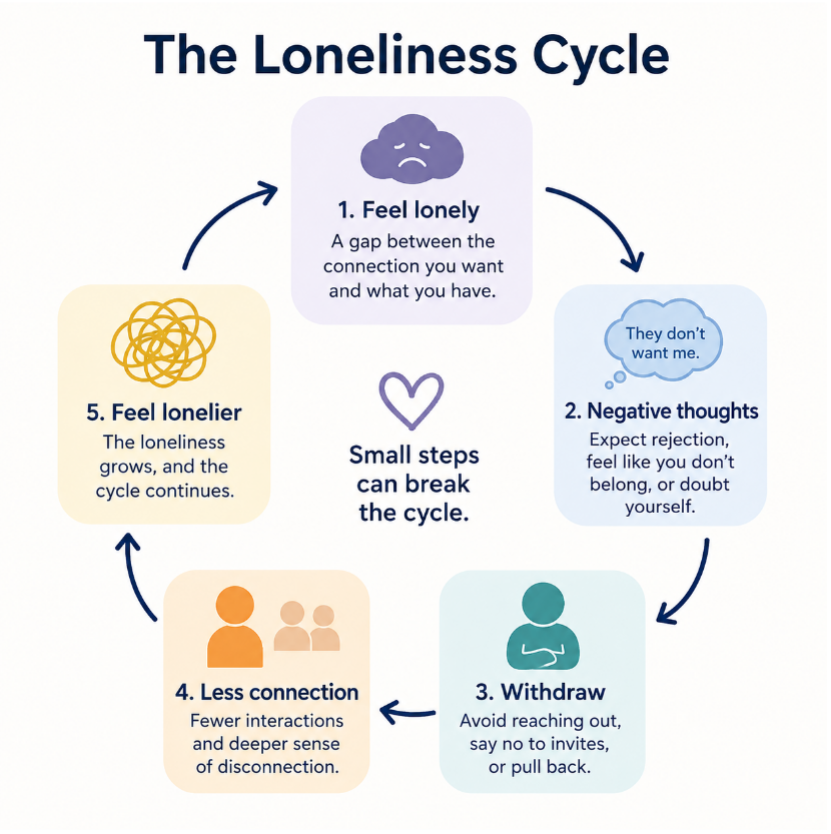
Loneliness is a common human experience that most people encounter at some point in their lives. It can affect people of all ages, from children and teenagers to adults. Yet despite how common it is, many people hesitate to talk about it for fear of being judged. By understanding what loneliness is, why it occurs, and how we can respond to it, we can better recognize it in ourselves and others and feel more empowered to seek support when needed.
What Is Loneliness?
Loneliness is the distressing feeling that arises when there is a gap between the social connection we want and the connection we experience. It is a subjective experience, meaning that two people can have similar social lives but feel very differently about how connected they are. Importantly, loneliness is not the same as being alone. A person can feel lonely even when surrounded by others, while another person may spend a great deal of time alone and feel socially connected and fulfilled.
Why Do We Feel Lonely?
Humans are wired for connection. Throughout history, belonging to a group helped keep people safe and supported. As a result, it is believed that loneliness evolved as an adaptive signal that alerts us when our need for meaningful social connection is not being met, much like hunger signals the need for food or thirst signals the need for water. Just as hunger motivates us to seek food, loneliness is believed to motivate us to seek meaningful social connection.
Although everyone experiences loneliness from time to time, some people are more vulnerable to it than others.
This vulnerability is shaped by a combination of biological, psychological, and social factors. These include individual differences in how we experience and respond to social connection and disconnection, our ability to cope with and regulate emotions, and the way we perceive and interpret social situations. Past experiences, such as bullying, social isolation, or early relationships with caregivers and peers, can also shape how we experience loneliness.
Does Loneliness Always Look the Same?
Loneliness can vary in its duration and intensity. For some people, loneliness is transient, consisting of brief and occasional feelings that come and go. Others may experience situational loneliness following a major life change or transition, such as moving, starting a new school or job, the end of a relationship, or the loss of a loved one. For some, loneliness becomes chronic, persisting over a long period of time. While occasional loneliness is a normal part of life, chronic loneliness has been associated with a greater risk of mental health difficulties.
What Keeps Loneliness Going?
Loneliness can sometimes become a self-perpetuating cycle. When people feel lonely, they may begin to expect rejection, interpret social situations more negatively, or withdraw from others. Although these responses may feel protective in the short term, they can reduce opportunities for meaningful connection and reinforce feelings of loneliness. Recognizing this cycle is the first step toward breaking it.
Why Are Teenagers Especially Vulnerable to Loneliness?
The teenage years are a developmental period during which feelings of loneliness become more common. As young people grow, friendships and peer relationships become increasingly important, while social interactions become more complex. Teenagers also become more aware of how they are perceived by others and often place greater value on belonging, acceptance, and social status. As a result, experiences of rejection, exclusion, or difficulty forming meaningful relationships may feel particularly painful during this stage of life. Although occasional loneliness is a normal part of the teenage years, persistent or chronic loneliness is not and may have a significant impact on emotional well-being.
Some teenagers may be particularly vulnerable to loneliness. For example, teenagers with autism often report higher levels of loneliness than their non-autistic peers, despite many having a strong desire for social connection. Differences in social communication, along with higher rates of bullying, social exclusion, and difficulties developing and maintaining friendships, can create barriers to developing and maintaining meaningful social connections.
How Can Parents Support a Child or Teen Experiencing Loneliness?
Parents play an important role in supporting children and teenagers who are experiencing loneliness.
1. Listen Without Immediately Fixing
When children share feelings of loneliness, it can be tempting to jump into problem-solving mode. Instead, start by validating their experience. Simple responses such as, "That sounds really hard," or "I can understand why you would feel upset about that," can help children feel heard and understood. Feeling understood can be incredibly powerful and often creates the foundation for meaningful support and problem-solving.
2. Model Healthy Social Connection
Children learn a great deal by watching the adults around them. By maintaining supportive relationships, reaching out to friends and family, and asking for help when needed, parents can model the importance of connection and healthy relationships.
3. Focus on Quality Over Quantity
Some children worry that having only one or two close friends means something is wrong. Remind them that meaningful friendships are often more important than having a large social circle.
4. Encourage Opportunities for Connection
Support your child in finding activities that align with their interests. Friendships often develop more naturally when children engage in shared activities such as sports, clubs, arts programs, volunteering, or community groups.
5. Support Social Confidence and Skills
Encourage your child to take small, manageable social steps, such as starting a conversation, joining a group activity, or inviting a peer to spend time together. While these situations may feel uncomfortable at first, positive social experiences can help build confidence and strengthen feelings of connection over time.
6. Help Challenge Unhelpful Thoughts
Children and teens who feel lonely may begin to assume that others do not like them, that they will be rejected, or that they do not belong. Gently encourage them to consider alternative explanations and test these assumptions through real-life experiences. Helping children develop more balanced and flexible ways of thinking can make it easier to build and maintain meaningful relationships.
7. Know When to Seek Professional Support
If your child's loneliness is persistent, causing significant distress or interfering with their daily functioning, consider seeking professional support. A mental health professional can help identify underlying factors contributing to loneliness and work with your child to build coping skills, strengthen relationships, and foster meaningful social connection.
A Final Thought
Loneliness is a normal part of the human experience, not a reflection of your worth or a sign that something is wrong with you. While it can be painful, loneliness is also changeable. Meaningful connection often begins with small steps, whether that's reaching out to someone, joining a shared activity, or strengthening an existing relationship. With time, patience, and support, it is possible to break the cycle of loneliness and build meaningful, lasting connections.
References
Bauminger, N., Shulman, C., & Agam, G. (2003). Peer interaction and loneliness in high-functioning children with autism. Journal of Autism and Developmental Disorders, 33, 489–507.
Bayat, N., Fokkema, T., Mujakovic, S., & Ruiter, R. A. C. (2021). Contextual correlates of loneliness in adolescents. Children and Youth Services Review, 127, 106083.
Cacioppo, J. T., & Patrick, W. (2008). Loneliness: Human nature and the need for social connection. Norton.
Cacioppo, S., Grippo, A. J., London, S., Goossens, L., & Cacioppo, J. T. (2015). Loneliness: Clinical import and interventions. Perspectives on Psychological Science, 10(2), 238–249.
Deckers, A., Muris, P., & Roelofs, J. (2017). Being on your own or feeling lonely? Loneliness and other social variables in youths with autism spectrum disorders. Child Psychiatry and Human Development, 48(5), 828–839.
Heinrich, L. M., & Gullone, E. (2006). The clinical significance of loneliness: A literature review. Clinical Psychology Review, 26(6), 695–718.
Masi, C. M., Chen, H.-Y., Hawkley, L. C., & Cacioppo, J. T. (2011). A meta-analysis of interventions to reduce loneliness. Personality and Social Psychology Review, 15(3), 219–266.
Preece, D. A., Goldenberg, A., Becerra, R., Boyes, M., Hasking, P., & Gross, J. J. (2021). Loneliness and emotion regulation. Personality and Individual Differences, 180, 110974.
White, S. W., & Roberson-Nay, R. (2009). Anxiety, social deficits, and loneliness in youth with autism spectrum disorders. Journal of Autism and Developmental Disorders, 39(7), 1006–1013.